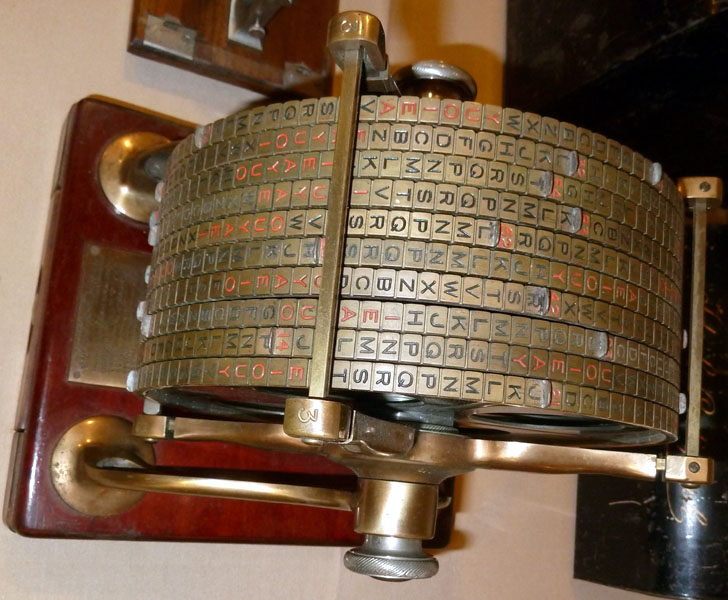
The cryptocode was a commercial cryptographic device created in the 1920s. Its intended use was to secure telegraphic communications while avoiding the higher charges commanded by unpronouncable text.
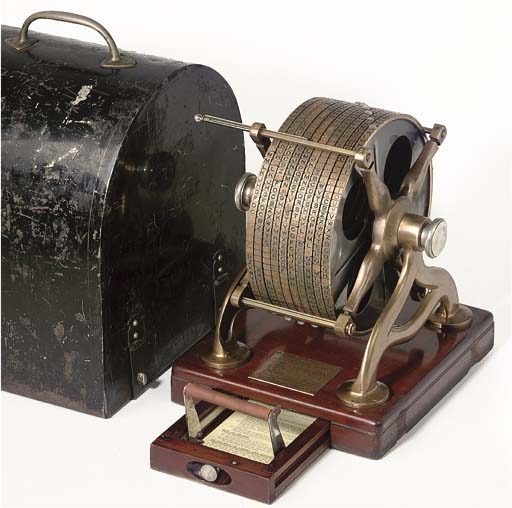
It is composed of 10 metal discs, each with 4 different alphabets along the rim. They are supported by a frame which also has 4 “register bars”, markers for reading the plain or cipher text.
The device stands on a wooden base with a drawer holding an intruction notice and that can be used as a cradle for holding the discs.
Use
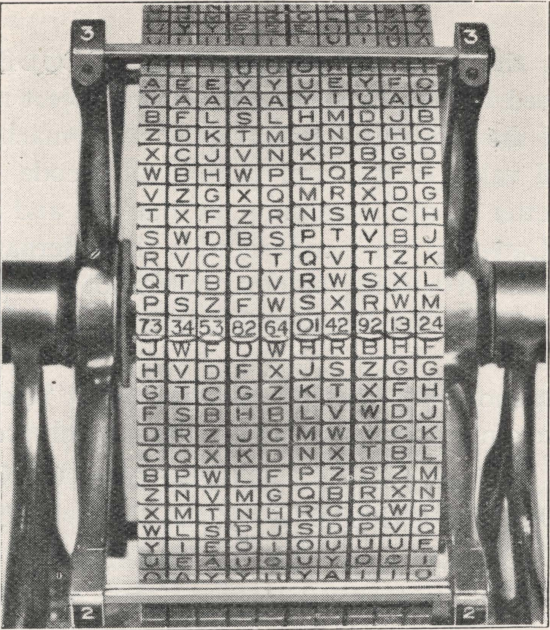
Let the key be: 2-3 / 73:34:53:82:64:0l:42:94:13:24 / 1-3.
- The first two numbers (2-3, green) indicate the register bars between which the chosen alphabets must appear.
- The last two numbers (1-3, red) indicate the number of the register bar where the plain text must be built up and that of the bar where the ciphertext will be read off, respectively.
- The numbers in between indicate the order of the discs (each first digit of a pair) and the number of the alphabets (each second digit) that must appear between the chosen register bars.
The 10 discs are ordered on the spindle according to that key, and rotated so the key alphabets appear between the selected registers.
The sleeves at the end of each quadrant arm are depressed. Because a prominent stop divides the 4 alphabets on each disc, this makes sure that the discs can only rotate along a full alphabet.
To encipher
The frame is rotated until the preselected register bar is in front, then the discs are rotated individually to make the intended message appear at the bar.
A locking bar is inserted so the discs can no longer rotate independently from each other or the frame.
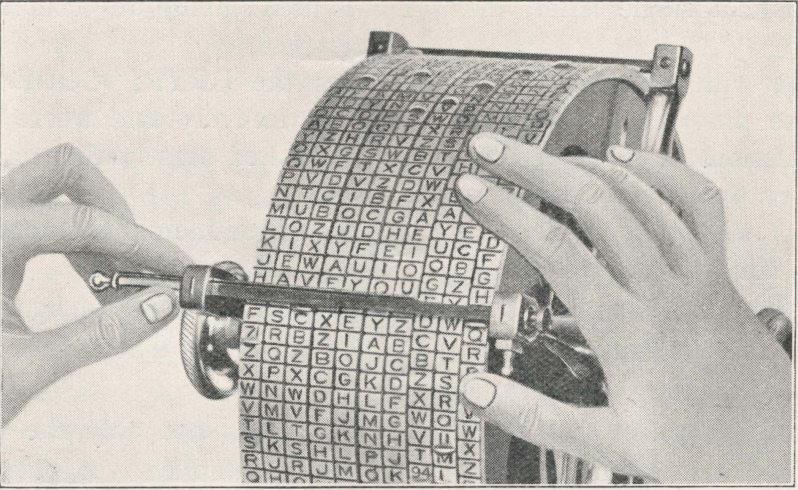
The frame-and-discs ensemble is rotated to show the second preselected register bar, where the cipher text is read off.
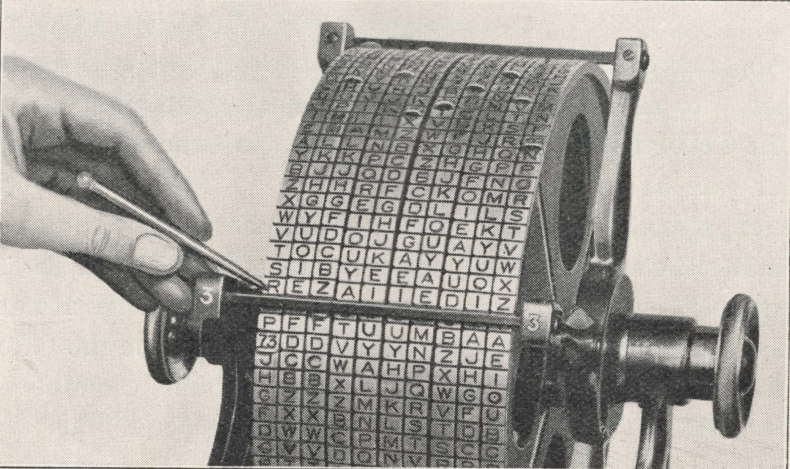
The key (order or position of the discs) may be changed after each 10-letter section, or kept the same.
To decipher
The process is the same, with the ciphertext built up at one register and the plain text read off another.