
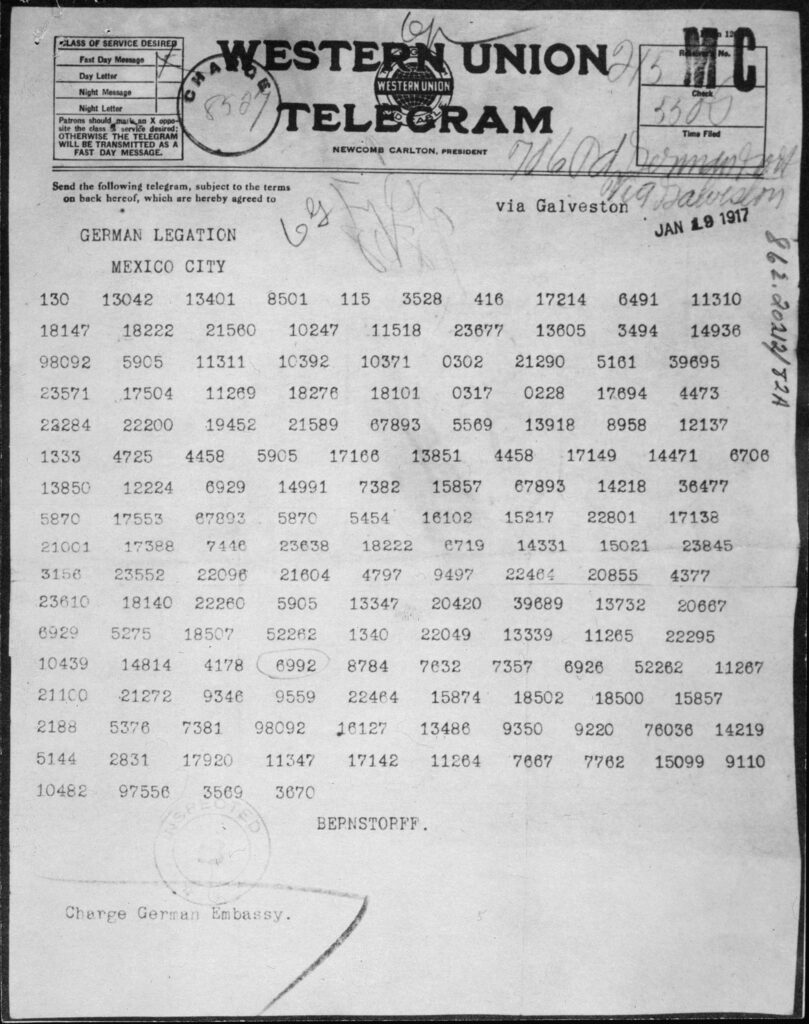
Here is a timeline of events related to the Zimmermann telegram affair.
- February 2nd, 1848: End of the Mexican-American war of 1846-1848; Mexico cedes 529,000 square miles (1,370,000 km2) to the United States. This corresponds to California, Nevada, Utah, most of Arizona, the western half of New Mexico, the western quarter of Colorado, and the southwest corner of Wyoming.
- August 4, 1914: The British declare war on Germany.
- August 5, 1914: British cable ship CS Alert cuts all cables linking Germany directly to the Americas.
- August 1914: The British establish a blockade of Germany.
- May 7, 1915: German U-boat U-20 sinks the Lusitania, killing 1,197 people including 128 Americans and causing an outrage.
- June 2nd, 1915: Following the Lusitania crisis, U.S. President Wilson agrees at the request of Ambassdor von Bernstorff to let the State Department transmit German coded messages on its diplomatic cable running from the U.S. Embassy in Berlin to Washington, via London.
- September 1st, 1915: Germany announces the end of unrestricted submarine warfare in passenger ships.
- March 24, 1916: A German U-boat attacks the passenger ship Sussex.
- April 18, 1916: Following the attack on the Sussex, the United States threatens to break diplomatic relations with Germany unless it stops attacking passenger and merchant ships.
- May 4, 1916: Germany yields to the ultimatum and promises not to attack passengers ships and unarmed merchant ships.
- January 9, 1917: Starved for resources by the blockade, Germany decides to again undertake unrestricted submarine war.
- January 13, 1917: A draft of the Zimmermann message is prepared, to by sent to Eckardt, German Minister in Mexico, on the Deutschland cargo submarine on the 15th.
- The U-boat’s trip is canceled, the message is prepared to be sent as a telegram instead.
- January 16, 1917: The telegram is sent via the U.S. State Department cable to Ambassador von Berstorff in Washington, with instructions to send it to von Eckardt in Mexico City.
- January 17, 1917: Room 40 has intercepted the telegram, Nigel de Grey and probably Dilwyn Knox start decoding it.
- January 19, 1917: Von Bernstorff receives the telegram and has it reencoded in Code 13040 and transmitted to von Eckardt in Mexico City.
- February 1st, 1917: Germany resumes unrestricted submarine warfare.
- February 3rd, 1917: The United States sever diplomation relations with Germany, Ambassador von Bernstorff is sent back to Germany.
- February 19, 1917: Admiral Hall of Room 40 receives a copy of all the telegrams sent from the German Ambassy in Washington to Mexico City, among them the Zimmermann telegram encoded in Code 13040.
- February 20, 1917: Von Eckardt presents the German proposition to Mexican Foreign Minister Candido Aguilar Vargas.
- February 24, 1917: President Wilson receives the telegram.
- March 1st, 1917: The telegram is published in newspapers. Some members of Congress challenge its authenticity; the U.S. Ambassador in London is asked to decode the telegram for proof.
- March 2nd, 1917: Nigel de Grey decodes the telegram as received in Mexico (in Code 13040) in front of Edward Bell of the U.S. Embassy in London, proving its authenticity.
- March 3rd, 1917: Arthur Zimmermann admits to sending the telegram.
- April 6, 1917: The United States declare war on Germany.
- April 14, 1917: Mexico President Carranza rejects Germany’s offer of alliance.