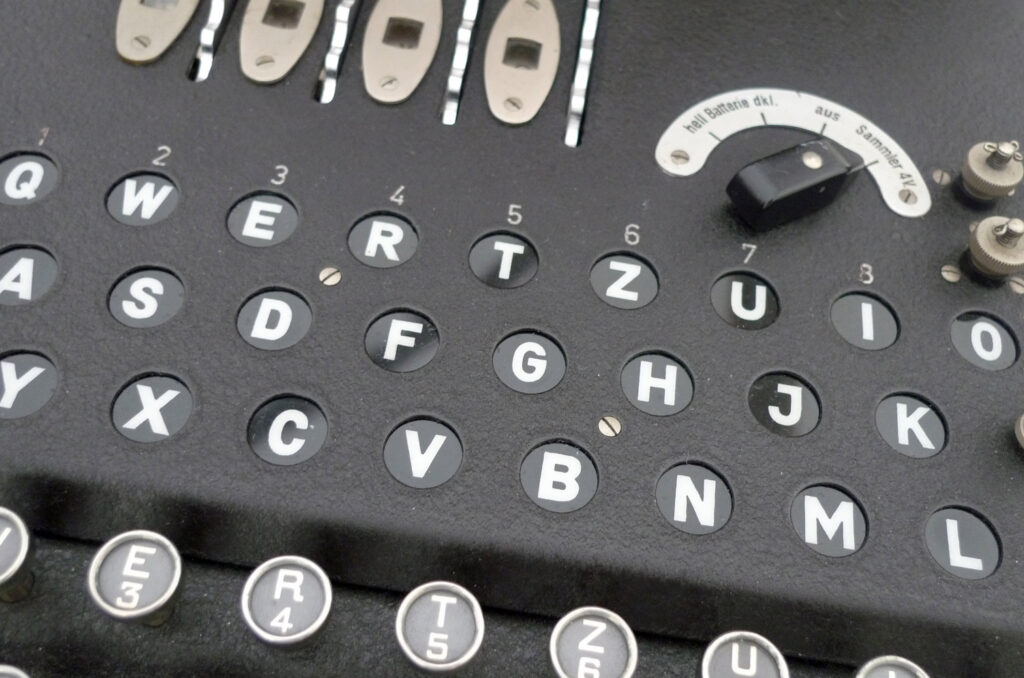
The Enigma was an electromechanical cipher machine invented in the 1920s and used by the German military before and during World War II.
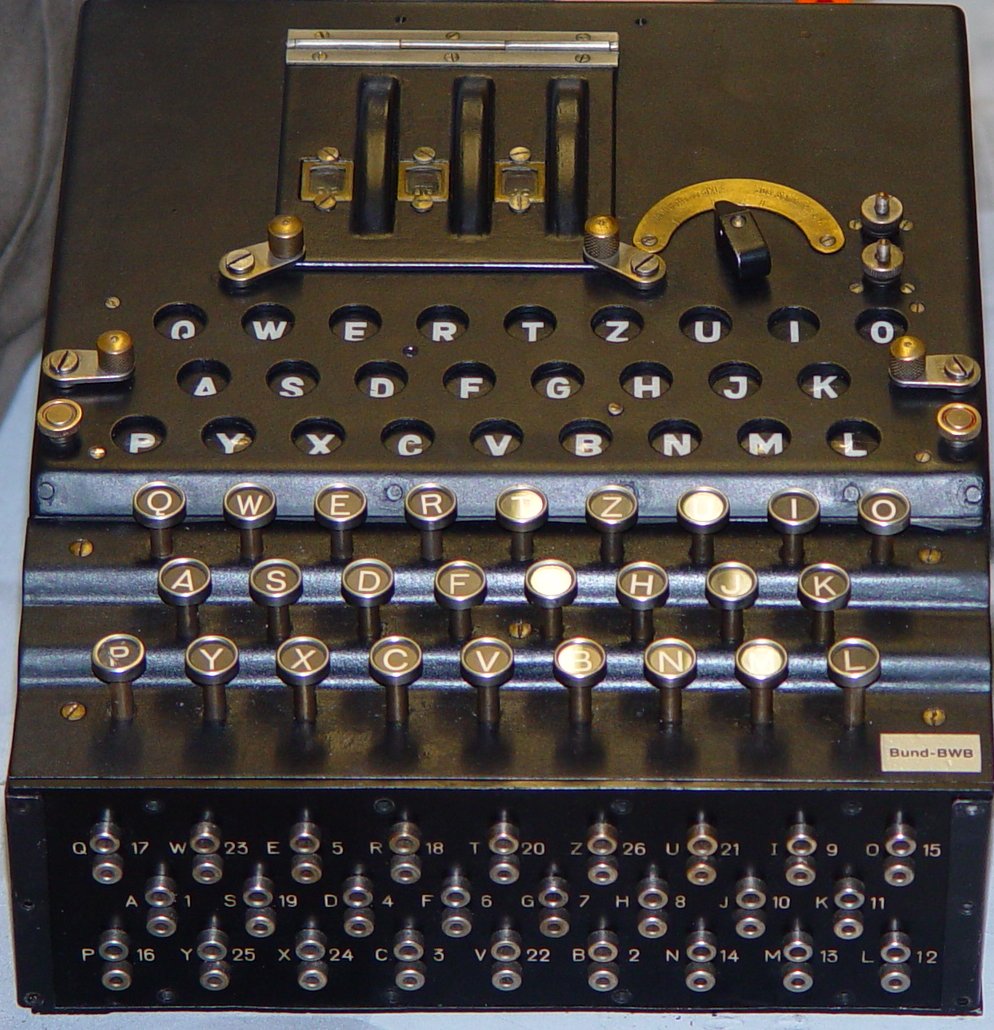
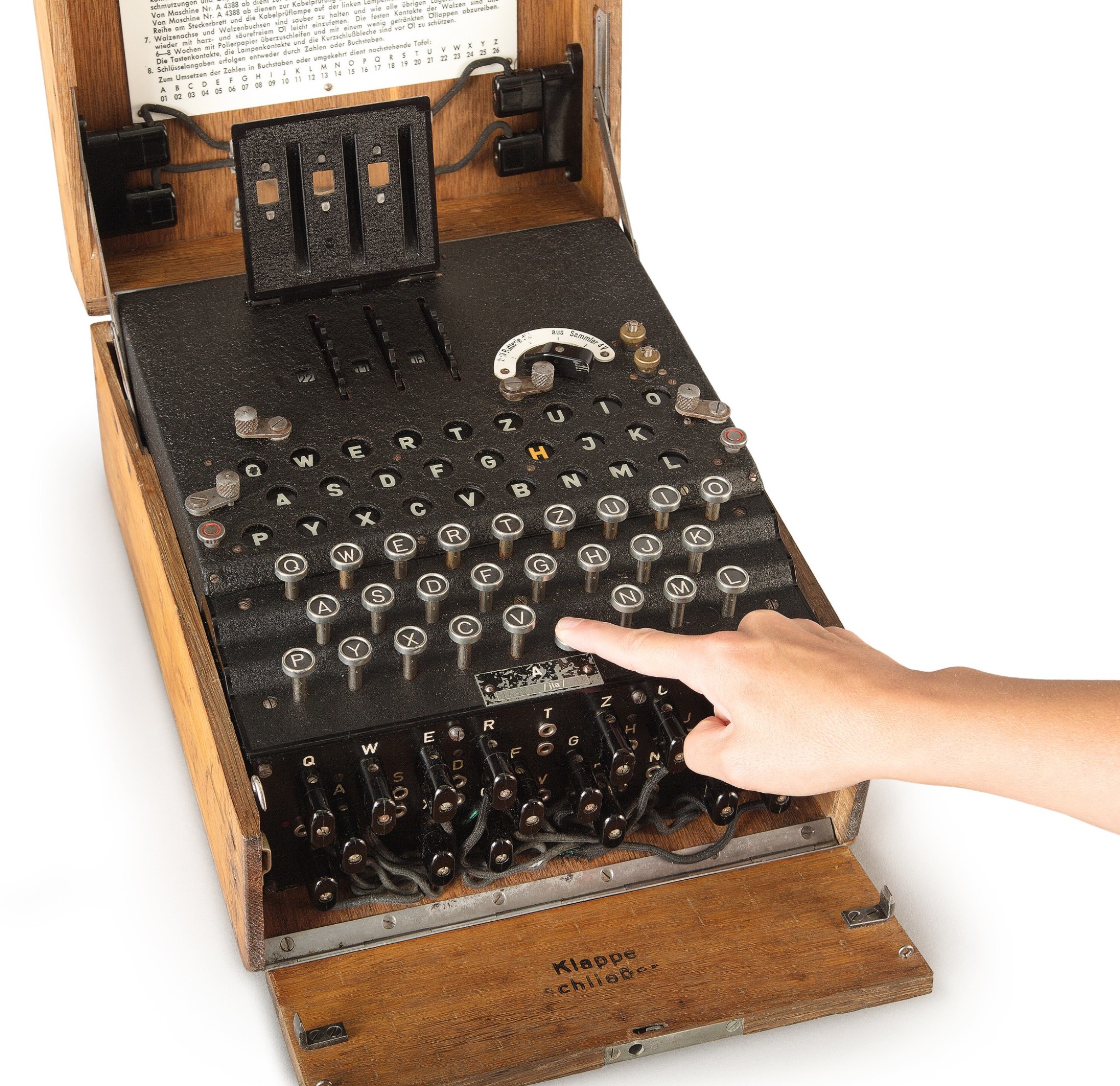
It looked like a typewriter with a German “QWERTZ” keyboard, except it had a lamp panel, and pressing a key turned a bulb on, indicating the corresponding cipher letter.
It was first broken before the war by a team of Polish mathematicians working at the Cipher Bureau.
After the war broke out, cryptanalysts at Bletchley park in Great Britain built upon their work and were also able to break the encryption, scaling up their decrypting abilities with mechanical devices called “bombes”.
Use
Enigma’s encipherment is reciprocal: the same procedure is performed to decrypt cipher text and to encrypt plain text.
The machine must first be set up according to the key:
- Select the chosen rotors
- Rotate the digit ring rotate around the rotor core (Ring stellung)
- Put the rotors in the proper order in the machine
- Rotate the rotors so the selected indicators appear in the windows (Gründstellung)
- Plug the cables in the plugboard input jacks to connect the selected pairs of letter
The machine is ready to use; a key press will illuminate a bulb under the corresponding plain letter (or cipher letter).
Cryptology
The Enigma was a rather secure system, which nonetheless had some vulnerabilities.
- The main weakness of the Enigma is that no letter is ever encrypted as itself, which allows cryptanalysts the use of cribs (probable words).
- .The rotors had only 1 (2 for Navy rotors VI, VII, and VIII) turnover notch, making the period too regular.
Moreover, its security was compromised by poor operating procedures.
- Army and Air force operators were allowed to select the rotor indicator settings. This resulted in easily guessed settings: letters close on the keyboard (like “QWE”), repeated letters (like “TTT”), existing words (like “HIT” and “LER”), or the name of the operator’s girlfriend.
- The number of plugboard cables was always the same during the war, 10.
The M4 Enigma, used in the U-Boats nets, was harder to break because it had unique features and stricter operating procedures.
- It had a fourth, thin rotor between the rotor stack and the special, thin reflector.
- There were 8 rotors to chose from, compared to the 5 used in the other branches.
- Operators did not get to choose the rotor indicator settings, they took them from a key book.
The security of the Enigma could have been improved by several ways.
- Issuing more rotors (like the Navy did), or even rewireable rotors (like the UKW-D reflector).
- Adding turnover notches to make the period more irregular.
- Using a variable number of cables in the plugboard, for example between 7 and 11.