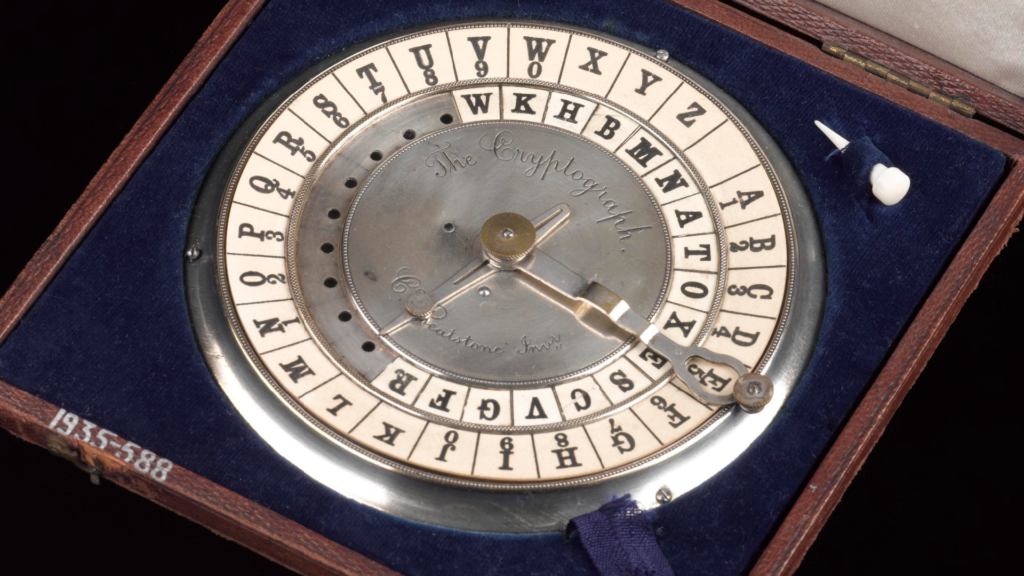
Charles Wheatstone, prolific British scientist and inventor, invented the Cryptograph in the 1860s and presented it at the 1867 Paris exposition. The device attracted interest there—a Colonel Aimé Laussedat reported about it before the French Military commission, declaring it indecipherable—but doesn’t seem to have had commercial success.
American cryptologist William Friedman broke the cipher and described how in his 1918 publication Several Cipher Machines and Methods for their Solutions.
Few devices are still known to exist; one is in the Science museum in London and another was sold for £1,687.50 in 2017.
Wheatstone’s cryptograph was widely considered the first modern cipher device for a long time, but it turned out that a mechanical device using the same cryptographic principle, a plaintext and a ciphertext alphabet of different lengths, had been invented about half a century earlier. It is believed to have been invented by Decius Wadsworth in 1817 because it bears his name and that year. It is not known if it was produced commercially or if the only known device, which has been owned by the Hamden Historical Society since around 1936, was in fact the only one made.
On this device the inner ring bore the regular alphabet, while the outer alphabet consisted of the 26 letters plus digits 2 to 8 which could be ordered according to a key. Instead of hands, there were fixed windows showing the plain and corresponding cipher letters, and the discs themselves rotated.
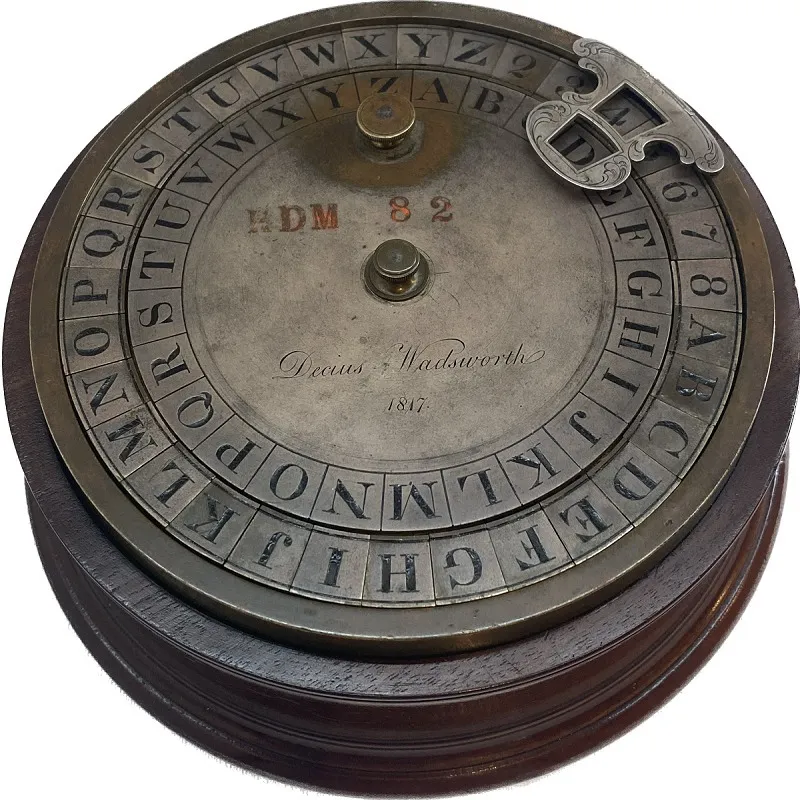
This device offered more security than Wheatstone’s device, using 33 alphabets instead of 26. It created an aperiodic poyalphabetic substitution, whereas the U.S. and Confederate armies were still using the Vigenere cipher 45 years later.
William Friedman even said of Wadsworth in 1944, “I should say that he was far ahead of any other American of his day in his concept of cryptographic mechanism”.