
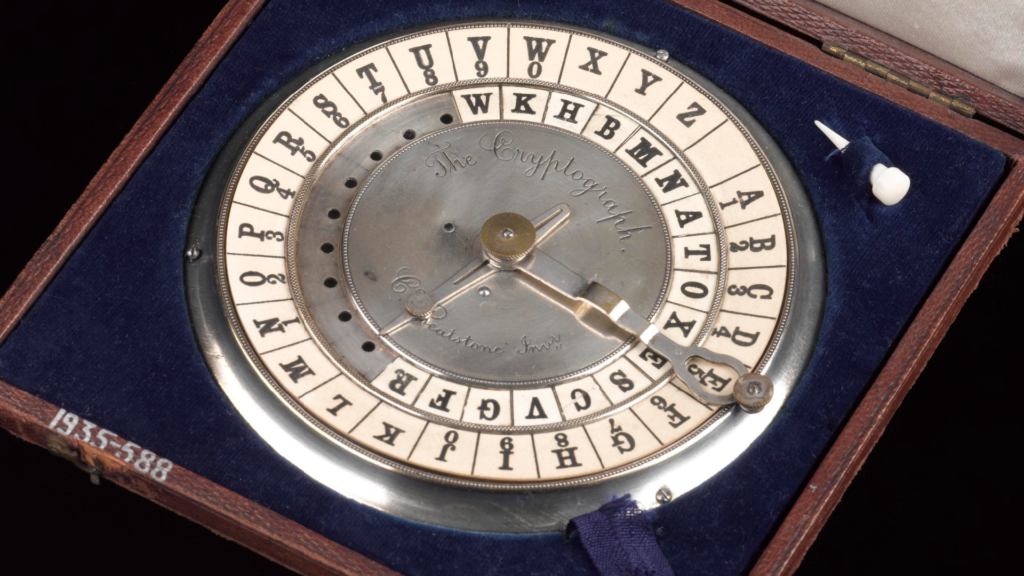
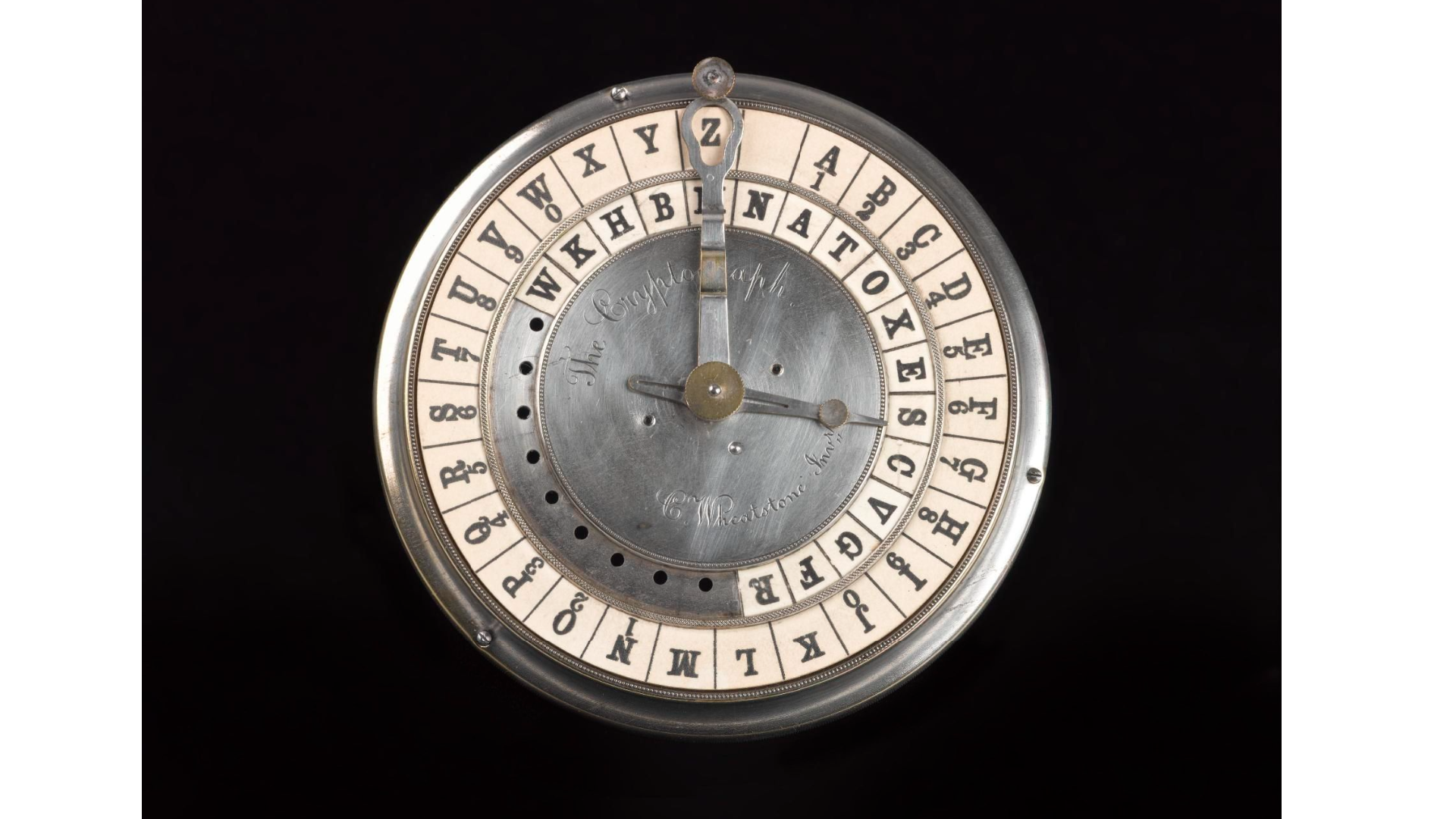
The Wheatstone cryptograph was a cipher device invented by Charles Wheatstone around 1867.
It has 2 alphabets arranged in rings. The outer ring is fixed and holds the alphabet in regular order, plus a space or blank. The inner ring has 26 positions in which individual letters can be inserted.
The device has two hands connected to gears which have a different number of teeth, so that when the long hand makes a complete turn the short hand also make a full turn and advances one position.
Use
To set up the device, the inner alphabet is ordered according to the key, which may be created by any chosen way although Weatstone proposes a method.
Wheatstone’s method for building the alphabet from a keyword
- Write the keyword, then the remaining letters of the alphabet horizontally below it. If a letter appears more than once in the keyword, the later occurrences are still written down, but struck through. For example, with the keyword “Sebastopol”:
S E B A S T O P O L
C D F G H I J K M N
Q R U V W X Y Z- Take the letters off vertically, omitting those that have been struck through
S C Q E D R B F U A G V H W T I X O J Y P K Z M L N- The letters are put in the inner ring in that order, with the first (here, S) placed under the blank.
Wheatstone recommends to then move the hands to point at the blank. The starting position of the hands could be different, however, and part of the key to add security.
In the same manner, the direction of rotation was assumed by Wheatstone to always be clockwise but could be different and an additional part of the key.
To encipher
Turn the long hand in the chosen direction until the plain text letter appears in its window: the letter the short hand points to is the cipher letter.
Keep turning the long hand, always in the same direction, and writing down the letter given by the short hand.
- A space between words is enciphered the same way as the letters, with the long hand pointing to the blank.
- When a double letter occurs, either one is omitted or an unusual letter (like Q) is inserted between them.
- At the end of a sentence, Wheatstone recommends to reset the hands at their starting positions and to indicate this in the ciphertext with a dash.
To decipher
Deciphering is done the same way as enciphering: the long hand is turned in the same direction until the small hand points to the cipher letter, and the plain letter is then read off the long hand.