
Appearance and dimensions
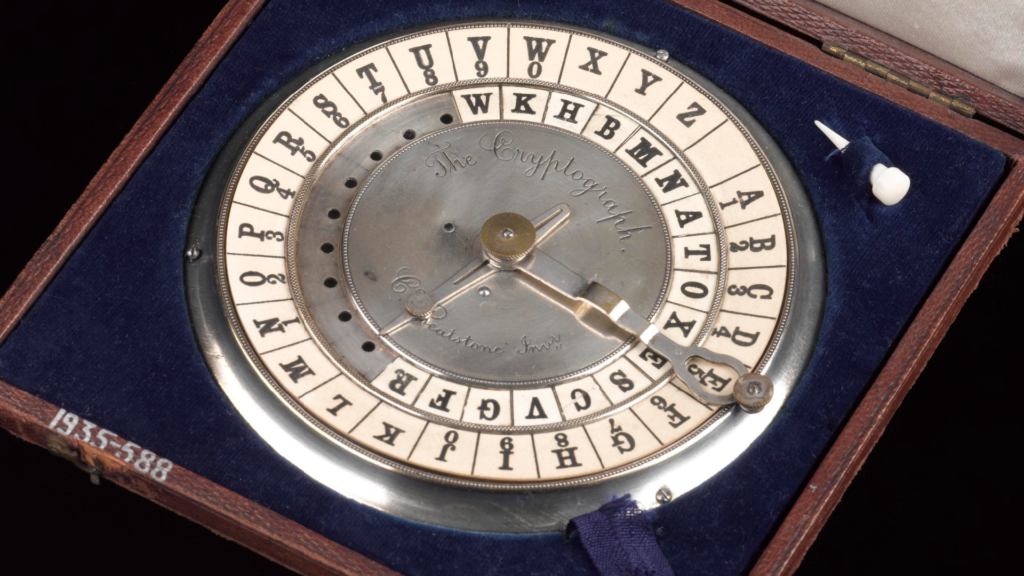
- The device is made from a metal which appears to be silver, or silver-plated copper. It is about 97mm in diameter.
- The face is engraved with “The Cryptograph” and “C. Wheatstone Inv,,r”
- The outer alphabet, in regular order, also bears the digits from 1 to 0 under some letters (from A to J, and again from N to W).
- Originally the device had 26 little individual letters with pegs, which could be inserted in the 26 holes in the inner ring to form the key alphabet. Some of these have been lost in the surviving units.
- The individual letters can be replaced by cardboard rings with key alphabet written upon, to allow for quick switching of alphabets.
- A little ivory pin was used to remove the letters by pushing them from below.
- The device has 3 screws with pointed ends, which allows it to be placed firmly on a soft surface and be operated with one hand.
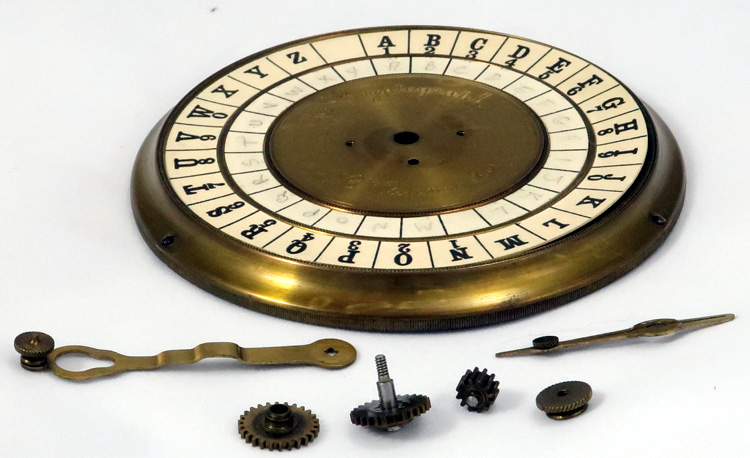
- The small hand rotates along the axis of a 26-toothed gear, the long hand around a 27-toothed gear. These gears are stacked on top of each other and connected via an idler gear.
Cryptology
Wheatstone assured that his device was very secure because a letter wouldn’t always be enciphered by the same letter.
Indeed, this system is a polyalphabetic substitution employing 26 alphabets irregularly, with the alphabet being used changing depending on the plain text, but it has several weaknesses that the cryptanalyst can attack.
- The main weakness is that, if the cipher text contains a double letter (e.g. “ZZ”), the corresponding plain text must be two letters that follow each other in the alphabet, but in reverse order (e.g. “TS” or “ON”). This also applies if a letter appears between double letters (e.g. “ZRZ” might be “T_S”). Generally, when different occurrences of a letter appear close to each other in the ciphertext, this indicates that their plain text equivalent are close to each other in the alphabet.
This could be avoided by using an irregular alphabet in the outer ring.
- If, as Wheatstone recommends, a dash is used to indicate the end of a sentence and the resetting of the hands’ positions, then the cryptanalyst knows
- where every sentence ends and begins
- that every first letter of sentence has been taken from the same starting alphabet
This could be avoided by enciphering an unusual letter like “X” to indicate a new sentence.